Pech Merle or Lascaux: which to visit, and why not both
When did Lascaux close, and why?
Lascaux was discovered in 1940, in Montignac in the Dordogne, and opened to the public after the war. Within twenty years, visitor numbers had altered the cave’s atmosphere: carbon dioxide, heat, humidity, then algae and deposits on the walls. In 1963, the state closed the cave to the public. It never reopened. Lascaux II, a partial replica, opened in 1983; Lascaux IV, a complete reconstruction in a modern interpretation centre, in 2016.
Pech Merle learned its lesson in real time. A daily quota of 700 visitors, groups of 25, no photos allowed, and booking mandatory. This is why you can still enter the original. The full story is in history and discovery.
What you’ll see in each
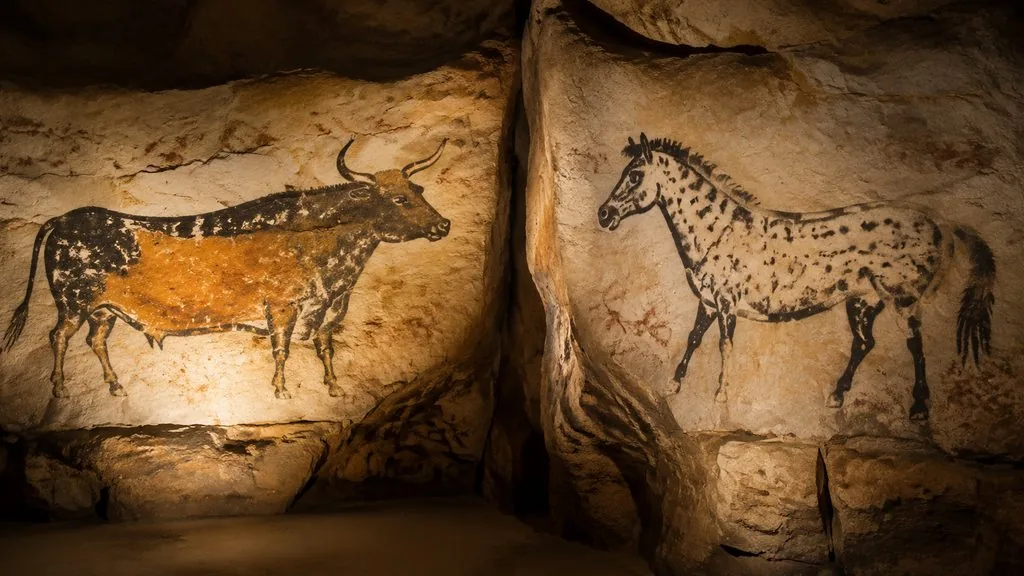
At Lascaux IV, you see an exact, full-scale replica in a controlled environment, with digital tools to understand each figure. It’s comfortable, well-lit when needed, and educational. You leave having understood Lascaux. But you haven’t actually been inside Lascaux.
At Pech Merle, you descend a staircase, the temperature is 12°C, the ground is damp in places, and the guide lights up a wall and turns off the lights. The black frieze, the negative handprints, the footprints of the adolescent, the spotted horses dated to around 29,000 years ago—everything is exactly where it was created. Marco, in July, summed it up: seeing original drawings from 25,000 to 30,000 years ago. The list of the fourteen stations is in what to see in the cave.
What works
- Pech Merle: the original paintings, just metres away
- Pech Merle: concretions and footprints in the same visit
- Pech Merle: museum and film included in the ticket
- Lascaux IV: complete replica, very clear, no such tight quota
Good to know
- Pech Merle: 700 places per day, booking required
- Pech Merle: one hour’s visit, no photos, 12 °C
- Lascaux: you don’t see the cave itself, you see a replica
- The two sites are a full day’s drive apart
Which one to choose
You want to have been inside a decorated cave, not in front of a replica: Pech Merle. You’re travelling with someone who fears the cold, damp, or enclosed spaces, or you want to fully understand the art of Lascaux with screens and time: Lascaux IV. You’re based in Cahors or Toulouse: Pech Merle is within reach, Lascaux is not in a day trip. You’re in Sarlat: Lascaux is nearby; Pech Merle requires a full day, and be aware, the private excursion from Sarlat goes to Rocamadour and Saint-Cirq-Lapopie, not the cave.
Two in one trip
This is what I recommend for those with three days. Day 1: Sarlat and Lascaux IV. Day 2: Drive to the Lot via Rocamadour, or via Gourdon and the Cougnac cave, another unique decorated site. Day 3: Pech Merle in the morning, Saint-Cirq-Lapopie in the afternoon, overnight in Cahors. Visiting Lascaux before Pech Merle has one advantage: you arrive at the original knowing what you’re looking at. For combinations, see the Lot Valley.
Book Pech Merle before booking anything else. Lascaux IV has greater capacity; it’s the Pech Merle time slot that’s in short supply in summer. See booking and tickets.
Frequently asked questions
When did Lascaux close?
In 1963, following damage caused by visitor numbers. Since then, replicas have been visited: Lascaux II (1983) and Lascaux IV (2016). Pech Merle, however, is visited in its original form with a visitor quota—see booking and tickets.
Is Pech Merle an original cave?
Yes. The paintings you see are those discovered in 1922, dated between 29,000 and 16,000 years ago, in the cave where they were created. The route is described in what to see in the cave.
Can you visit Lascaux and Pech Merle in the same day?
No, not reasonably. The sites are a full day’s drive apart, and each requires two hours on-site. Plan for two days, with Rocamadour or Cougnac in between—see the Lot Valley.